

ChatGPT-4o: The next frontier in GenAI? | Impetus Blog

Is Open AI’s ChatGPT-4o the next frontier in GenAI?

Dive into how ChatGPT-4o’s cutting-edge features are setting new standards, revolutionizing industries, and enhancing user experiences.

July 2024

ChatGPT-4o has emerged as a groundbreaking innovation in the dynamic world of artificial intelligence. Introduced by OpenAI in March 2024, this state-of-the-art language model is more than just an upgrade—it’s a game-changer. ChatGPT-4o sets new standards with exceptional capabilities, including fluency in over 50 languages and remarkable contextual understanding. Let’s dive deep and learn more about ChatGPT-4o’s revolutionary capabilities and what differentiates it from its predecessor.

Key features

ChatGPT-4o offers a wide range of significant new features, including the following:

  • Multimodal integration: GPT-4o can handle a combination of text, audio, image, and video as input and generates any combination of text, audio, or image output.
  • Fast response: It can respond to audio inputs in as little as 232 milliseconds, with an average of 320 milliseconds, which is similar to human response time in a conversation.
  • Improved language capabilities: Matching GPT-4 Turbo in English and code, ChatGPT-4o significantly improves on non-English languages.
  • Cost and speed: GPT-4o is twice as fast and 50% cheaper in the API compared to GPT-4 Turbo.
  • Large data handling: GPT-4o can handle input and output of up to 25,000 words of text, over 8x the 3,000 words capacity that ChatGPT could handle with GPT-3.5.

Key use cases

ChatGPT-4o boasts a wide range of capabilities that enhance productivity and efficiency across various industries. Here are some of the key applications of this advanced language model:

  • Content creation: Businesses can leverage ChatGPT-4o for generating blog posts, articles, social media content, and marketing materials tailored to their target audience.
  • Language translation: With its superior understanding of English and non-English languages, ChatGPT-4o facilitates seamless communication across linguistic barriers.
  • Email and communication: ChatGPT-4o enhances email communication by understanding conversation context, leading to more effective internal and external correspondence.
  • Healthcare: In healthcare, ChatGPT-4o can analyze patient data, provide medical information, and assist in patient communication.
  • Software development: ChatGPT-4o improves the accuracy of coding tasks, debugging, and other software development processes.
  • Media and entertainment: ChatGPT-4o supports various creative processes in the media and entertainment industry from scriptwriting to trend analysis.
  • Enterprise-grade security and privacy: Offering high-speed access, extended context windows, and advanced data analysis capabilities, ChatGPT-4o ensures enterprise-level security and privacy, compliant with TSL 1.2 and SOC 2 standards.

How does ChatGPT-4o work?

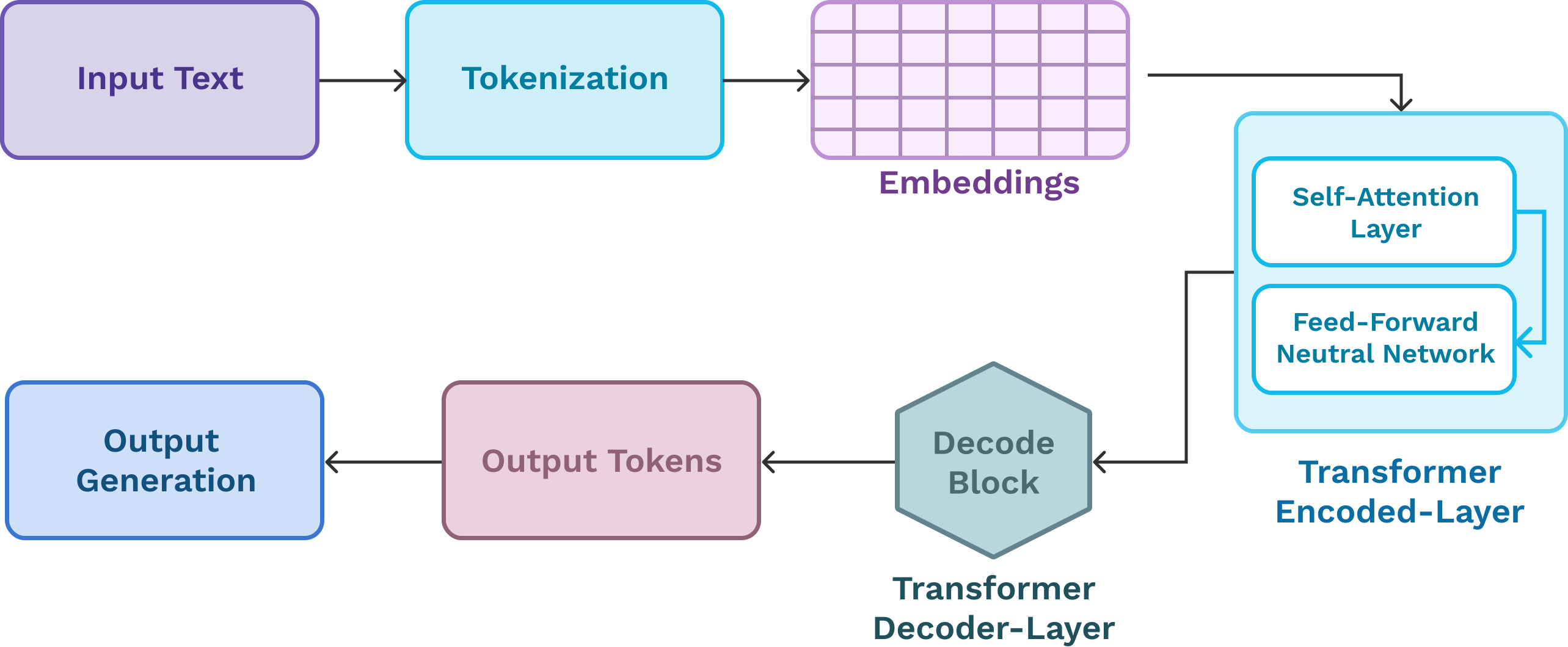
 ChatGPT-4o operates through a series of sophisticated steps to understand and generate human-like responses. Here’s a breakdown of its process:

  1. Input parameters: The user provides input parameters or a question.
  2. Tokenization: Input is split into smaller chunks called tokens (words or characters) for easier processing.
  3. Embeddings: Tokens are transformed into high-dimensional vectors known as embeddings to capture semantic meaning.
  4. Transformer encoder layers:
    • Self-attention layer: This layer computes attention scores to determine the relevance of each token in relation to others in the sequence.
    • Feed-forward neural network: Adds non-linearity and complexity, enabling the model to learn intricate patterns.
  5. Decoder: Final hidden states from the transformer layers are used to predict the next token in the sequence.
  6. Output tokens: Decoder generates tokens individually, converting them back into human-readable text.
  7. Output generation: Based on the predicted tokens, various strategies (e.g., greedy search, beam search, sampling) are employed to form the final output.

This intricate process allows ChatGPT-4o to produce coherent, context-aware responses that enhance user interaction across various applications.

Is ChatGPT-4o here to stay?

ChatGPT-4o represents a significant leap in AI technology, marked by several key advancements that strongly suggest its long-term dominance in the GenAI space. Let’s delve into why this groundbreaking model is here to stay:

Advanced capabilities

ChatGPT-4o’s multimodal integration and improved context management capabilities set it apart from its predecessors and competitors. Its ability to process and generate text, audio, image, and video inputs and outputs makes it an incredibly versatile tool, essential for a wide range of applications.

Cost efficiency

One of the most compelling aspects of ChatGPT-4o is its cost efficiency. Being twice as fast and 50% cheaper than GPT-4 Turbo, it offers significant economic advantages for businesses. This cost-effectiveness democratizes access to advanced AI, allowing large enterprises and small and medium-sized businesses to leverage its capabilities.

Robust security

Security is a critical concern in today’s digital landscape, and ChatGPT-4o addresses this with enterprise-grade security and privacy features. These measures ensure safe and secure deployment in sensitive environments, making it a trustworthy option for industries like healthcare, finance, and any sector dealing with confidential information.

Customization and ethical use

ChatGPT-4o’s advanced fine-tuning options and improved filtering for ethical usage are noteworthy. These features allow for greater customization to meet specific industry needs while ensuring the AI’s application remains ethical and aligned with societal norms. This balance between customization and ethical considerations is crucial for building and maintaining trust with users and stakeholders.

Key areas of improvement for ChatGPT-4o

While ChatGPT-4o represents a significant advancement in AI, there are areas for potential improvement and growth, including the following:

  • Contextual understanding and retention: Even though ChatGPT-4o has made strides in managing context over long conversations, there is room for improvement in maintaining context consistency across even more extended and complex dialogues. Enhancing the model’s ability to retain and recall information over multiple interactions would significantly improve user experience, particularly in customer service and virtual assistant applications.
  • Multimodal integration: Presently, ChatGPT-4o supports multimodal inputs and outputs, but there is potential to refine and expand these capabilities further. Improving the seamless integration and processing speed of text, audio, video, and image data will enhance its versatility. Additionally, more sophisticated handling of complex multimodal queries can provide users with richer and more accurate responses.
  • Language diversity and nuance: ChatGPT-4o has improved non-English language capabilities, but there is still a need to enhance its proficiency in lesser-spoken languages and regional dialects. Expanding the model’s understanding and generation of nuanced language features, idiomatic expressions, and cultural context will make it more inclusive and effective globally.
  • Ethical AI and bias mitigation: While ChatGPT-4o emphasizes ethical development and usage, continuous efforts are needed to minimize inherent biases in AI responses. Implementing more advanced bias detection and mitigation strategies will help ensure that the AI’s outputs are fair, unbiased, and ethically sound. Regular audits and updates to its training data can further support this goal.
  • User control and customization: Giving users more control over the AI’s behavior and responses can enhance the overall experience. This includes offering customizable settings for tone, verbosity, and interaction style. Greater transparency in how the model generates responses can also build user trust and engagement.
  • Integration with emerging technologies: As new technologies emerge; it will be crucial to ensure that ChatGPT-4o can seamlessly integrate with them. This includes compatibility with the latest IoT devices, augmented reality (AR) and virtual reality (VR) systems, and other cutting-edge technological advancements.

What’s next for ChatGPT-4o: Future innovations and business opportunities

It is expected that ChatGPT-4o will drive significant advancements and create numerous new business opportunities. Here are some key areas where it is expected to drive innovation and growth:

  • Multimodal integration: ChatGPT-4o is set to expand beyond traditional text-based interactions by incorporating images, video, and audio. This multimodal integration will greatly enhance its versatility, making it invaluable for customer support, content creation, and training programs.
  • Personalization: One of the most exciting prospects for ChatGPT-4o is its ability to offer highly personalized experiences. Tailored solutions for specific industries, such as customer service and healthcare, will enable targeted marketing efforts and improve customer relationship management (CRM).
  • Enhanced problem-solving: With improved reasoning capabilities, ChatGPT-4o will significantly enhance strategic decision-making and process optimization. Its ability to analyze complex scenarios and provide insightful recommendations will be a game-changer for businesses looking to streamline operations and boost efficiency.
  • Third-party integration: The seamless integration of ChatGPT-4o with existing systems through APIs and plugins will revolutionize automation and data analysis. This interoperability will enable businesses to easily incorporate advanced AI capabilities into their workflows, driving greater productivity and innovation.

Final thoughts

ChatGPT-4o represents a significant step in GenAI, offering enhanced capabilities that outpace previous models in the GPT series. Its ability to handle multimodal inputs, extended context windows, and diverse applications across various industries marks it as a transformative GenAI solution. As ChatGPT-4o evolves, it is likely to influence the future of AI and business, contributing to ongoing innovation and efficiency.

Authors:

Swati Sinha,

Swati is an analytics engineer with over two years of experience in machine learning, deep learning, computer vision, and natural language processing. She specializes in developing AI-driven solutions that enhance business performance across finance, retail, manufacturing, and surveillance sectors. Proficient in AWS-native solutions and skilled in scalable deployment, Swati believes in driving innovation and efficiency in her domain

Atharv Sakalley

Atharv is an analytics engineer with four years of experience in the healthcare industry. He specializes in machine learning, deep learning, and natural language processing, leveraging AI to improve business outcomes. He is proficient in data extraction and analysis and deploying scalable systems. Atharv has demonstrated expertise in developing AI chatbots and working across multiple domains.

Learn more about how our work can support your enterprise