
A Solution Framework for Real-Time Claims Processing, built on Databricks Lakebase - Impetus

A Solution Framework for Real-Time Claims Processing, built on Databricks Lakebase

Introduction: Why the Industry Needs Real-Time Claims Processing

Insurance claims processing is a critical function for insurers, covering the full lifecycle from claim submission and validation to adjudication and settlement. It involves multiple stakeholders who rely on timely, accurate information to act with confidence.

In today’s digital-first environment, policy holders expect instant claim updates and faster settlements — without compromising operational efficiency or compliance. However, many traditional claim systems remain fragmented and batch-driven, resulting in delayed approvals, inconsistent data views, and reactive decision-making. These limitations reduce visibility, slow down operations, and impact customer experience in an industry where responsiveness and transparency are key differentiators.

The Problem: Fragmented Systems and Delayed Decisions

Most insurance enterprises still operate on fragmented architectures where claims platforms, underwriting tools, and analytics environments function in isolation. This creates several critical challenges:

  • Batch-driven processing: Claims are processed in periodic cycles rather than in real time, delaying approvals, settlements, and overall response times.
  • Data silos and inconsistency: Disconnected systems maintain separate copies of data, resulting in inconsistent views across channels and reduced trust in information.
  • Reactive decision-making: Fraud detection, risk evaluation, and actuarial calculations often occur after transactions are completed, increasing financial exposure.
  • Complex data movement: ETL pipelines are required to move data between operational systems and analytics platforms, introducing latency and operational overhead.

Together, these limitations make it difficult for insurers to deliver a responsive customer experience while also increasing cost, complexity, and risk.

The Solution Framework: A Lakebase-Centric Approach

To address these challenges, Impetus designed a solution framework for real-time claims processing, built on Databricks Lakebase, that unifies transactional operations and analytics on a single, real-time platform.

In this solution framework approach, all core business transactions—such as customer updates, claim submissions, and payment processing—are captured directly in Lakebase, which serves as the operational system of record. Lakebase provides low-latency, ACID-compliant processing with high concurrency, ensuring that data remains consistent and immediately available.

Unlike traditional architectures that separate operational and analytical systems, this solution framework keeps data within a single platform and changes are synced into the Databricks Lakehouse. This eliminates the need for complex ETL pipelines and ensures that analytics and AI operate on fresh, consistent data.

Architecture Overview: Unified Operations and Analytics

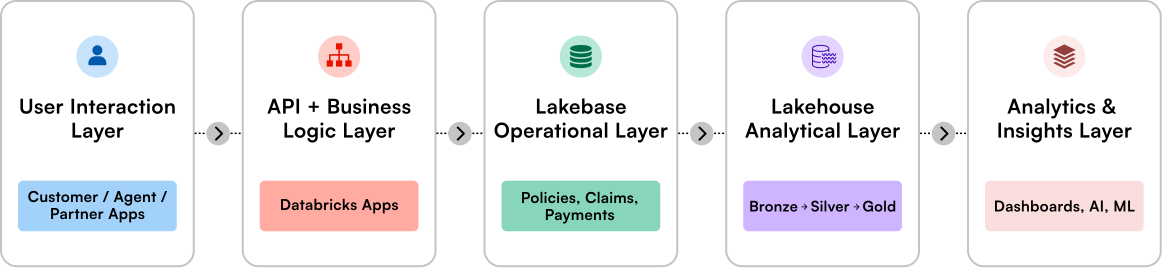
The solution framework architecture is designed to seamlessly connect business applications, transactional processing, and analytics:

  • Frontend applications: Customers, agents, and partners interact through web and mobile applications for activities such as claim submissions.
  • Databricks Apps (API layer): Acts as the backend layer, handling API orchestration, validation, and business logic.
  • Lakebase (operational layer): Stores all transactional data—including customers, claims, and payments—and ensures real-time updates across the system.
  • Business engines: Claims, underwriting, and payment engines operate directly on Lakebase to execute business rules and decisions.
  • Lakehouse (analytical layer): Data from Lakebase is synced into the Lakehouse and organized into Bronze, Silver, and Gold layers for analytics and reporting.
  • Analytics and AI layer: Enables dashboards, fraud detection, risk scoring, and actuarial insights using tools such as Databricks SQL and MLflow.

The outcome is a single data foundation that supports both operational and analytical workloads, enabling real-time processing and decision-making.

Key Capabilities: What This Enables

By combining Lakebase with the Lakehouse, it delivers several powerful capabilities:

1. Real-time claims processing: Claims can be submitted, validated, and processed instantly, shortening settlement cycles and lifting customer satisfaction.

2. Unified data platform: Operational and analytical data coexist in the same platform, eliminating data duplication and ensuring a single source of truth.

3. Instant insights on live data: Fraud detection, risk scoring, and actuarial calculations can run on live transactional data rather than on delayed datasets.

4. Elimination of ETL overhead: Removing complex data pipelines reduces latency, infrastructure cost, and operational complexity in one move.

5. High-concurrency processing: The platform supports simultaneous reads and writes, enabling real-time interactions across customer portals, underwriting systems, and analytics tools.

Business Impact: Transforming Claims Processing

The solution framework shifts claims processing from a reactive, batch-driven model to a proactive, real-time model, delivering measurable business benefits:

  • Faster claims settlement: Reduced turnaround time improves customer experience and satisfaction.
  • Improved risk management: Real-time insights help detect fraud and manage exposure proactively.
  • Operational efficiency: A simplified architecture reduces maintenance and integration costs.
  • Better decision-making: Access to live, consistent data enables faster and more informed business decisions.
  • Regulatory compliance: Unified governance improves traceability, auditability, and control.

Overall, insurers can operate more efficiently while delivering a more responsive and transparent experience to customers.

Conclusion: From Systems of Record to Systems of Action

Traditional systems were designed primarily to record the transactions. Modern insurers, however, need platforms that can act on those transactions instantly. By leveraging Lakebase as the operational backbone and the Lakehouse for analytics and AI, this solution framework bridges that gap, enabling real-time decisioning on a unified data platform.

The result is not just an architectural transformation but a fundamental shift in how claims processing are executed—from delayed processing to real-time, insight-driven action.

Learn more about how our work can support your enterprise