From Context Engineering to Decision Engineering - Impetus

From Context Engineering to Decision Engineering

Sit in on almost any enterprise AI discussion today and within minutes someone says “context.” Rightly so. I have long argued that many agentic AI investments fail to deliver because of missing context: the gap between what models can do in general and what they can do for a specific enterprise. Context remains foundational to scaling AI with trust.

But understanding a situation and being trusted to decide on it are different things. We increasingly use one word to describe both.

Customer data, documents, policies, memory, permissions, past decisions and user identity may all enter an AI system as context. Technically, they can all occupy a context window. Architecturally, however, they serve very different purposes.

As agents move from pilots into production, and from answering questions to taking actions, that distinction becomes critical. Context should not become a bag of tokens.

TypeSafe AI’s recent launch of Jev makes the point interestingly. Jev does not generate text. Given unstructured state and a bounded set of choices, it returns a structured, probabilistic decision. Whether Jev succeeds is for the market to determine. The more important question it raises is this: if AI is going to make decisions inside the enterprise, what exactly does it need to know?

“The right context” is no longer a precise enough answer.

One decision, five kinds of knowledge

Consider a simple enterprise decision. An AI system needs to determine whether a strategic customer should receive a $200,000 service credit.

To make that decision responsibly, it needs at least five different kinds of knowledge:

  • Facts: The customer generates $18 million in revenue, has experienced three critical incidents and renews in 90 days.
  • Policy: Service credits are permitted up to a defined percentage of contract value and under specific conditions.
  • Authority: The agent can recommend any amount but can independently approve only $5,000.
  • Experience: In comparable situations, customers accepted smaller credits combined with executive sponsorship and subsequently renewed.
  • Intent: Protect the customer relationship while maintaining commercial discipline.

These are not interchangeable.

Facts require provenance and freshness. Policies require applicability, precedence, versioning and exception handling. Authority requires identity, delegation and enforcement. Experience requires more than a historical decision: it requires the original situation, the judgment made, the action taken and, critically, the outcome. Intent requires an explicit objective and a clear understanding of which trade-offs the business is prepared to accept.

When AI is answering a question, these distinctions can remain largely invisible.

When AI is making a judgment and taking action, they become fundamental.

Intelligence is not authority

An AI system might determine, with high confidence, that the full $200,000 credit is the right commercial decision.

That does not mean it has the authority to grant it.

Being capable, being compliant and being authorized are three different things.

Enterprises have spent decades building structures around precisely these distinctions. We separate information from policy, expertise from decision rights and recommendations from approvals. We establish delegation hierarchies, learn from precedent and evaluate decisions against business objectives.

An agentic enterprise needs to be architected with the same discipline.

The Enterprise Decision Fabric

An enterprise agent does not simply need more information in its context window. It needs access to the institutional machinery the enterprise already uses to make judgments.

We think of this as an Enterprise Decision Fabric, with five distinct planes:

  • Fact: What do we know?
  • Policy: What framework governs this judgment?
  • Authority: Who or what is permitted to decide and act?
  • Experience: What have we learned from comparable decisions and their outcomes?
  • Intent: What are we trying to achieve?

Separating these planes also clarifies the role of the model.

Sometimes the right intelligence is a frontier LLM. Sometimes it is a specialized decision model such as Jev or a domain-specific predictive model. And sometimes deterministic business logic remains the most appropriate answer.

The agent harness has a different responsibility: planning, orchestration, tool and model invocation, state management, failure recovery and execution.

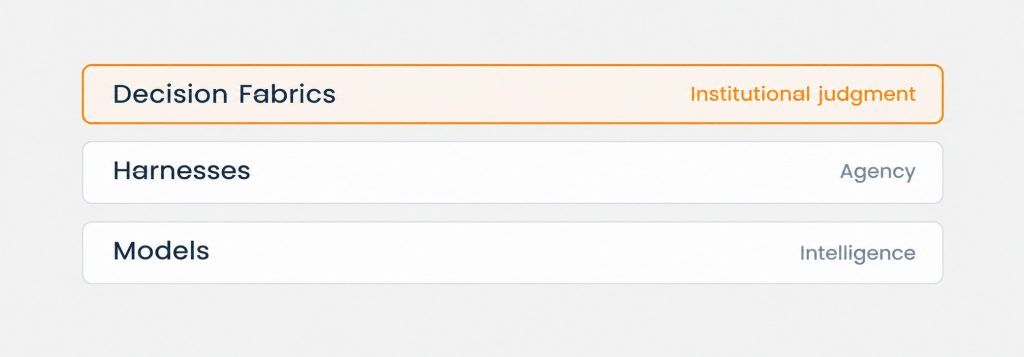
Models provide intelligence. Harnesses provide agency. Decision Fabrics provide institutional judgment.

What leaders should do now

  • Map where your agents already hold real decision rights and who granted those rights.
  • Treat policy and authority as systems that must be engineered, versioned and enforced—not paragraphs buried inside prompts.
  • Assign clear accountability for every agent’s decisions, including what it knows, what it can do and what controls apply before and after deployment.
  • Capture outcomes, not just decisions, so organizational experience becomes something future agents can learn from.
  • Design explicit boundaries between recommendation, approval and autonomous action.

We spent the last decade engineering enterprise data and the last two years learning to engineer context.

The next discipline is decision engineering: designing how the enterprise makes decisions, what institutional knowledge those decisions depend on, and where AI fits into that system.

Author

Nachiket Deshpande
Chief Executive Officer, Impetus Technologies

Learn more about how our work can support your enterprise