
The case for data estate modernization
A major mid-west health insurance provider manages vast volumes of sensitive claims and member data for over a million members. Its fragmented legacy estate—spanning Teradata, Talend, and multiple data quality platforms—limited agility, complicated data management, and drove up licensing and operational costs. Extensive validation and approval requirements further slowed reporting and delayed responsiveness to changing business and regulatory needs.
Key challenges:
- Fragmented healthcare data: Member, claims, and critical data scattered across legacy platforms was difficult to manage, govern, and use across the organization.
- Inconsistent data quality: Multiple quality engines and rules made it hard to maintain reliable data across healthcare processes.
- Regulatory reporting complexities: Stringent regulatory, third-party, and business validation requirements increased reporting effort.
- Reduced business agility: Legacy dependencies and fragmented processes slowed responses to evolving business, member, and regulatory needs.
- Limited AI readiness: Disconnected systems and legacy dependencies made it difficult for AI models and agents to consume enterprise data.
To ensure seamless access to quality care for its members, the health insurer chose to modernize its legacy data estate to a scalable, agile, AWS-based platform.

Transformed a fragmented legacy estate into a unified, governed data foundation on AWS, improving agility, scalability, and operational efficiency.
From legacy silos to a future-ready enterprise data platform
Impetus enabled the health insurance company to seamlessly modernize its fragmented data ecosystem into a future-ready data foundation on AWS—sunsetting legacy platforms, strengthening data reliability, and streamlining regulatory compliance.
Business benefits:
- Lowered analytics effort: Reduced analyst effort by ~35–40%, freeing teams to focus on higher-value priorities.
- Accelerated data platform adoption: Rapidly onboarded 400+ users, driving broader adoption of self-service analytics.
- Greater confidence in data: Improved trust in information supporting healthcare, business, and management decisions.
- Stronger regulatory readiness: Enabled the insurer to meet evolving regulatory and reporting requirements with greater ease.
- Increased business agility: Enabled faster responsiveness to rapidly changing healthcare and business needs.
- Seamless member experience: Maintained uninterrupted operations for 1M+ members throughout the transformation.
- AI-ready, domain-aligned data foundation: Unified healthcare data and developed new domains, including Commissions, enabling reusable data products for payer operations, member and provider insights, and advanced analytics.
Eliminated long-standing data barriers, accelerated enterprise-wide insights, and ensured AI-readiness—without a single day of business disruption.
How Impetus and AWS accelerated the modernization journey
Impetus’ ontology-led modernization solution, LeapLogic™ Suite, automated the end-to-end transformation of legacy workloads to a single, governed AWS Lakehouse—creating a scalable foundation for future growth.
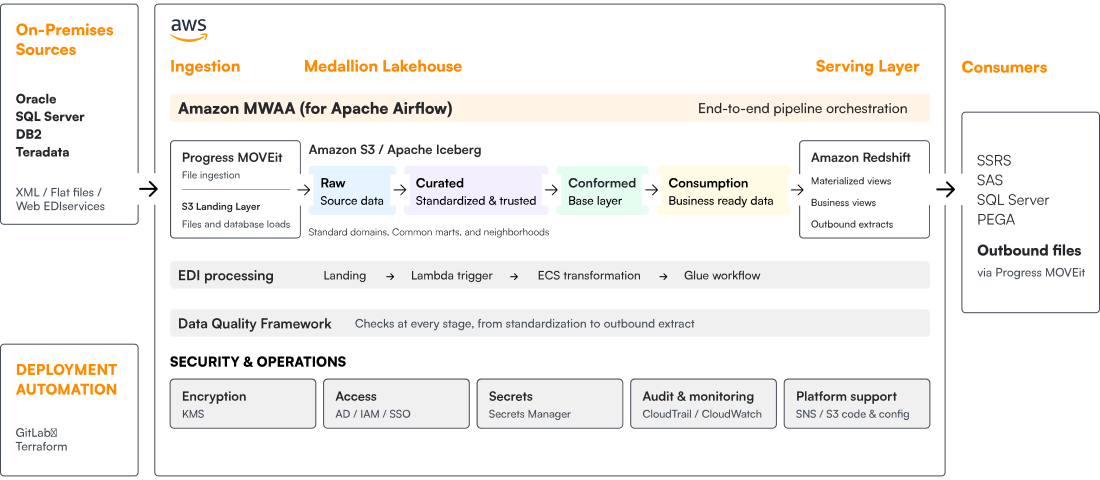
Modernizing a complex legacy data estate to a governed AWS Lakehouse
Solution highlights:
- Automation-led transformation at enterprise scale:Modernized 30,000+ data objects, 300+ Informatica workflows, 2,200+ WhereScape jobs, 1,100+ Talend jobs, and 6,000+ views using LeapLogic.
- Built a layered, governed AWS Lakehouse: Automated ingestion, transformation, and delivery of trusted data leveraging key AWS services like Glue, Redshift, MWAA, Lambda, and ECS.
- Established business-aligned data domains: Leveraged reusable accelerators for greenfield build, overcoming long-standing issues in domains like Commissions.
- Unlocked stranded data: Unified mission-critical healthcare data sources, making previously untapped data available for AI and business use cases.
- Data lineage & member–claims context: Used a Foreign-Key AI Agent to uncover undocumented data relationships, generate lineage, and automate reconciliation—establishing a stronger contextual foundation for member and claims insights.
- Trusted payer reporting: Strengthened data quality and validated 400+ SAS and SSRS reports against business, third-party and regulatory requirements, improving confidence in information used for health plan reporting.
- Security and governance by design: Enforced data quality frameworks, KMS encryption, IAM/SSO access control, Secrets Manager, and CloudTrail & CloudWatch for compliance and auditability.
- Healthcare data continuity: Modernized 21+ EDI formats and associated data flows while maintaining uninterrupted operations for 1M+ members, preserving critical healthcare information exchanges during the transition.
The modernization journey unlocked trusted healthcare data to power enterprise-wide analytics, regulatory reporting, member and provider insights, and future AI initiatives—while eliminating legacy complexity, lowering costs, and reducing manual effort to accelerate business agility.