

On March 27, 2024, Databricks dropped a bombshell in the AI world: DBRX, an open-source Large Language Model (LLM) that’s set to turn the industry on its head. Competing with heavyweights like OpenAI’s GPT series and Google’s Gemini 1.0 Pro, DBRX’s open-source nature and affordability make it a must-have for researchers and developers alike. Its user-friendly design and stellar performance position DBRX as a revolutionary AI tool.
Key features of DBRX
DBRX isn’t just another LLM. It’s a transformer-based, decoder-only model with a fine-grained Mixture-of-Experts (MoE) architecture.
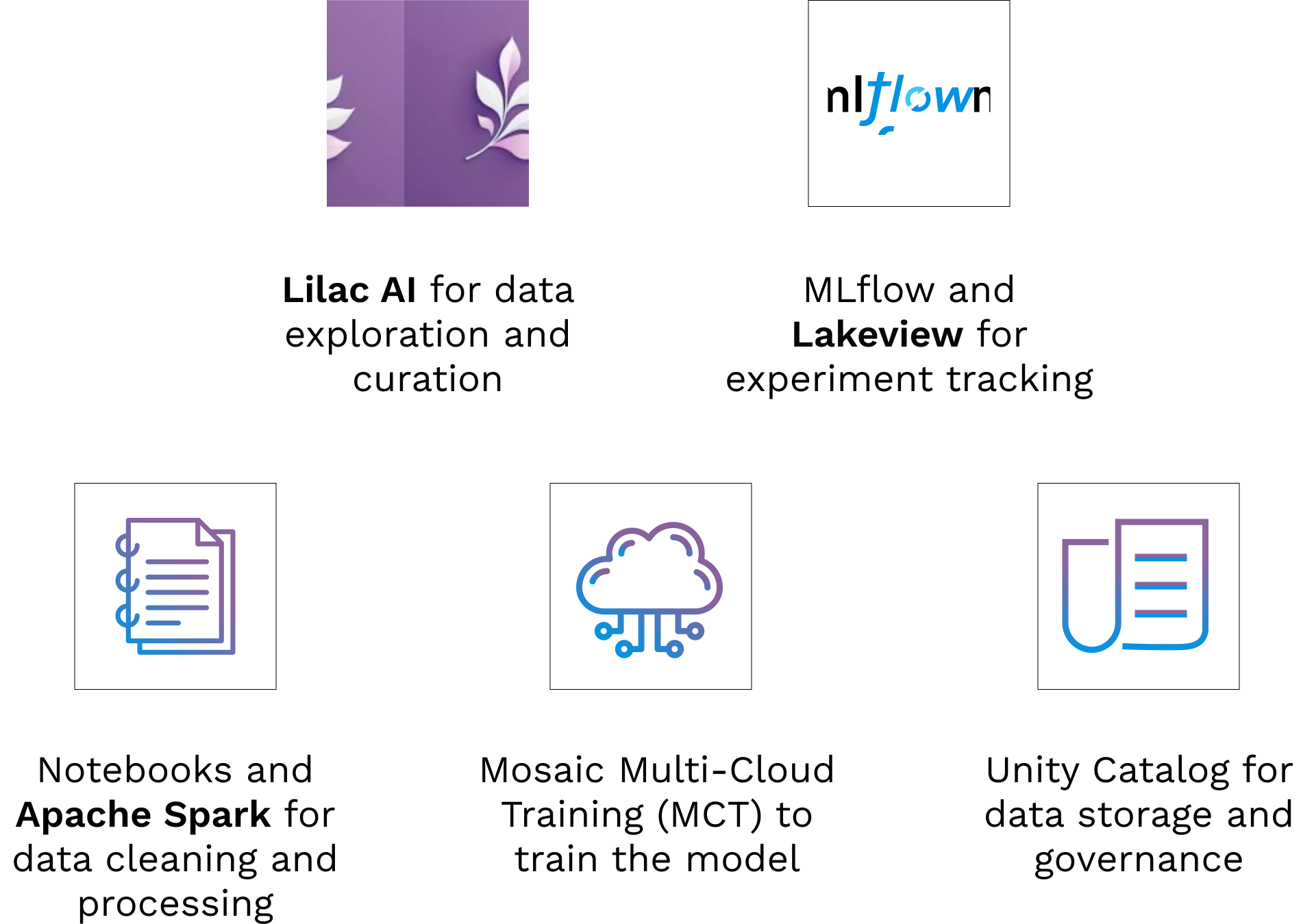
Here’s what makes it stand out:
- Text generation: DBRX excels at generating new text, utilizing a sequential transformer-based decoder and attention layers that focus on preceding words, making it ideal for applications in creative writing, content creation, and automated communication.
- Efficiency and performance: With 132 billion parameters and 36 billion active per input, DBRX offers remarkable computational efficiency. It is pre-trained on an extensive dataset of 12 trillion tokens of text and code, ensuring high-performance output and robust processing capabilities.
- Context mastery: DBRX can handle up to 32K context length, the highest among open-source LLMs. This capability allows it to maintain coherence and relevance in longer conversations and documents.
- Advanced attention mechanism: The model employs Grouped Query Attention (GQA) to improve efficiency, ensuring faster and more accurate input processing.
- Performance enhancers: Incorporates advanced features such as Rotary Position Encodings (RoPE) and Gated Linear Units (GLU), which further boost the model’s performance by improving the handling of positional information and enhancing layer efficiency.
- Effective tokenization: Utilizes GPT-4-like Tiktoken for more efficient tokenization, enabling better handling of diverse text inputs and enhancing overall processing accuracy.
- Sparse activation: Activates only select components (36 billion out of 132 billion parameters) during inference, significantly speeding up the process and reducing computational load.
- Expert and gate network: Features an Expert and Gate Network that directs tokens to the appropriate expert, allowing for specialization and improving the model’s ability to handle diverse tasks effectively.
- Dynamic pre-training curriculum: Employs a dynamic approach to pre-training, varying the data mix to ensure more effective token processing and adaptation to different types of content.