
Project Astra: An AI assistant revolution | Impetus Blog

Google’s Project Astra: The AI assistant revolution we didn’t see coming

Explore the game-changing features like visual guidance, multimodal interactions, everyday assistance, and wearable integration, while diving into the challenges and prospects of this AI leap.

July 2024

AI assistance has come a long way since the days of Siri and Alexa. Today, it’s about more than just responding to voice commands; it’s about understanding us deeper through predictive analytics, natural language processing (NLP), and personalized recommendations. Enter Project Astra, Google’s latest groundbreaking artificial intelligence leap unveiled by Demis Hassabis, the brilliant mind behind Google DeepMind, at the Google I/O event in May 2024. With advanced machine learning and NLP, Project Astra is poised to bring us closer to a future where AI seamlessly integrates into our daily lives, making us feel valued and understood.

The growing need for Project Astra

Have you ever felt that your AI assistant just doesn’t quite get you? As AI becomes more embedded in our routines, the need for assistants handling dynamic, real-time situations is more pressing than ever. Google recognizes this and aims to tackle the challenge of making AI conversations feel natural—something Project Astra is designed to achieve.

What truly captivates me about Astra is its unique ability to process visual data and provide context, making it an invaluable companion in personal and professional settings. Imagine an AI that understands your words and comprehends the visual and situational context, offering more accurate and relevant assistance. Astra’s potential to enhance your daily life is truly remarkable.

Is Project Astra here to stay?

Google’s Project ASTRA is designed as a long-term initiative. Currently in the prototype phase, it is gradually being evolved and will sooner get integrated into Google products and the Google developer’s ecosystem. The substantial resources and efforts Google is dedicating to ASTRA, along with its impressive demonstrations at major events like Google I/O, indicate their intention to make it a lasting component of their technology offerings.

What impresses us about Project Astra

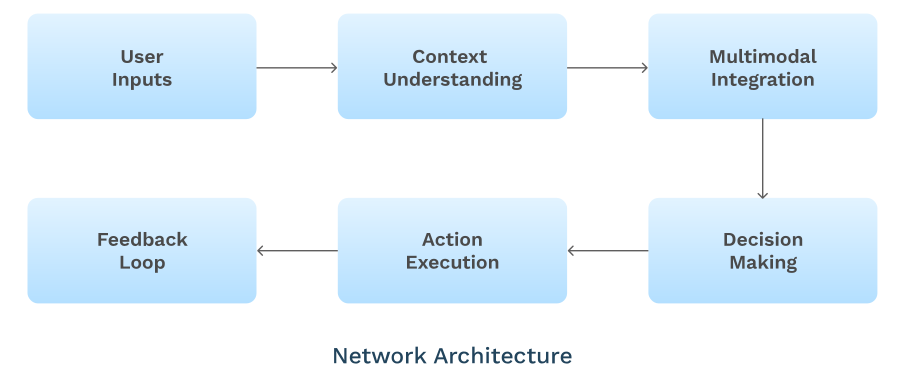
Let’s explore what makes Project Astra stand out. Its versatility and adaptability are game-changers. Unlike traditional AI assistants that rely on voice or text interactions, Astra supports multiple forms of communication, including drawings and images. This multimodal approach, illustrated in the diagram below, can revolutionize how we interact with technology, making it more accessible and intuitive for everyone.

And then there’s Astra’s potential integration with wearable technology, like AR glasses, enhanced by Google Gemini’s advanced predictive capabilities. This opens a world of possibilities for real-time assistance and augmented experiences, significantly impacting education, healthcare, and creative industries. Combining visual guidance and Gemini’s insights could revolutionize these fields, demonstrating AI’s potential to transform multiple industries.

Key capabilities

During the Google I/O event, Google showcased some truly impressive features of Project Astra:

  • Multi-method interaction: Astra communicates through voice, text, drawings, and images, catering to diverse user preferences and enhancing accessibility.
  • Visual guidance: Using smartphone cameras, Astra can identify objects, offer detailed insights, and provide creative suggestions using visual cues. For instance, it can identify speaker components or craft catchy phrases for a box of crayons.
  • Memory boost: Astra’s short-term memory allows it to temporarily remember object locations, a feature demonstrated when it successfully recalled the location of misplaced glasses.
  • Wearable compatibility: Astra’s potential for integration with wearable devices, like Google Glass, can offer real-time context and aid users with tasks such as enhancing diagrams or remembering object placements from their point of view.

Potential use cases for Project Astra

The potential applications of Project Astra are vast:

  • Real-time assistance: Imagine using AR glasses where Astra provides information about what you see, answers questions about objects, and assists with navigation. This could revolutionize how we interact with our surroundings.
  • Enhanced smart homes: Based on its knowledge of your home environment, Astra can track items, manage tasks, and give reminders, making smart home systems more intuitive and efficient.
  • Creative and learning tools: Astra’s ability to understand and generate content from visual inputs makes it a powerful tool for education and creativity, helping children learn through interactive stories or assisting artists with visual ideas.

Adoption challenges

Project Astra’s future hinges on its ability to integrate seamlessly into our daily lives without compromising speed, security, or user privacy.

One significant challenge will be reducing dependence on cloud-based processing to ensure faster, more reliable interactions. This might involve enhancing local processing capabilities, a trend gaining traction in the tech industry.

Another critical factor will be expanding Astra’s functionality. While the current capabilities are impressive, real-world applications demand a broader range of functions. This expansion will require continuous innovation and development, ensuring Astra remains versatile and practical across various scenarios.

Additionally, privacy concerns are paramount. The need for stringent data protection measures cannot be overstated as AI assistants become more integrated into our lives. Ensuring Astra can safeguard user data while providing personalized assistance will be crucial for its widespread adoption.

How will it reshape the future?

Project Astra has the potential to significantly impact several areas:

  • Everyday assistance: With its advanced contextual understanding and real-time processing, ASTRA can become a highly efficient personal assistant, helping with tasks ranging from finding misplaced items to providing detailed, contextual information about the user’s surroundings and day-to-day tasks.
  • Enhanced multimodal interactions: The ability to integrate and process multiple forms of input (visual, auditory, textual) will enable more natural and intuitive interactions with technology. This can transform how users engage with their devices, making technology more accessible and user-friendly.
  • Smart devices: Astra’s integration into smart glasses, phones, and possibly others could lead to more immersive and interactive experiences. For instance, augmented reality applications could be enhanced with real-time AI assistance, seamlessly providing contextual overlays and information.

Conclusion

Project Astra stands at the forefront of AI innovation, promising to seamlessly integrate into our daily lives and enhance productivity, connectivity, and user experience. Though still in early testing with no set launch date, Astra showcases Google’s vision for advanced AI assistance, with capabilities like diverse input processing, information retention, and wearable integration. However, significant work remains to realize its full potential.

The adoption of Astra could have profound societal impacts, from changing work dynamics to influencing daily habits. It will also raise important questions about data privacy, the digital divide, and ethical considerations. Ensuring Astra respects user privacy and operates within ethical guidelines will be crucial for its success.

Comparing Astra to AI initiatives from other tech giants, such as Apple’s Siri and Amazon’s Alexa, provides insights into the future of AI assistance. As Astra evolves, its development will be an exciting journey with significant implications for the industry.

Author:

Ashwin Kalyankar

Ashwin is an analytics engineer with four years of experience in machine learning, deep learning, and natural language processing. He is passionate about learning new technologies and has expertise in various projects, including image classification. Proficient in data analysis and data extraction, Ashwin has worked across multiple domains, such as finance, insurance, and eCommerce.